
Imposter Syndrome Resources for Executive Women
Practical tools to help women leaders recognise, understand, and overcome imposter syndrome at work. Because your success isn't luck — it's earned, deserved, and entirely legitimate.
Explore Imposter Syndrome Tools and Insights
The Reality of Imposter Syndrome in Leadership
That nagging voice telling you you're not qualified enough. The fear that someone will discover you don't really belong in your role. The tendency to attribute your success to your team, luck, timing, or anything except your own capabilities. If this sounds familiar, you're experiencing imposter syndrome at work, and you're far from alone.
Executive imposter syndrome affects high-achieving women disproportionately. You've earned your position through competence, hard work, and results, yet you still question whether you deserve to be there. You worry about being "found out" despite a track record of success. You downplay your achievements and over-prepare for everything, hoping no one will notice you're “not good enough”.
The irony is profound: imposter syndrome in female leaders typically affects those who are most capable. It shows up when you're stepping out of your comfort zone, breaking new ground, or achieving at pre-competence levels. Your imposter voice appears precisely because you're growing, learning, and taking on bigger challenges.
This isn't a character flaw or lack of confidence. It's a predictable pattern that emerges when competent women hold themselves to unrealistic standards. The very qualities that make you an excellent leader — attention to detail, high standards, commitment to excellence — can become challenges to your own confidence in yourself.
Keep reading to discover how to break free from these patterns

What Life Looks Like Beyond Imposter Syndrome
Can you see yourself walking into boardrooms knowing you belong there?
Picture yourself speaking up in meetings without second-guessing every word?
Imagine owning your achievements and accepting recognition without deflecting credit to your team, circumstances, or luck?
This is what life beyond imposter syndrome at work looks like:
Authentic Confidence
Trust your expertise without needing perfection. Asking questions shows curiosity and intelligence, not inadequacy.
Strategic Risk-Taking
Say yes based on your capabilities, not certainty. Treat learning curves as evidence of growth, not weakness.
Balanced Self-Perception
Acknowledge strengths and gaps with perspective. See mistakes as information, not proof of failure.
Sustainable Leadership
Lead without over-proving or over-preparing. Find a rhythm that sustains performance and wellbeing.
Clear Communication
Speak with confidence about your expertise. Share ideas without apology and advocate for your work.
Realistic Standards
Set achievable goals that value progress over perfection. Expertise grows through experience, not flawlessness.
Tools and Insights on Imposter Syndrome
Practical tools, masterclasses, and real-world insights to help you overcome self-doubt and step into your full capability with confidence.

Impeding Your Imposter Masterclass
Learn her secrets, uncover her weaknesses, and harness her power. This comprehensive workshop teaches you to recognise when your imposter appears, understand what triggers her, and develop practical strategies to transform self-doubt into strategic thinking.

Who’s YOUR Chief Imposter? Quiz
Discover which imposter shows up most often for you: the Perfectionist (focused on flawless execution), the Expert (must know everything), the Soloist (must do everything alone), the Natural Genius (everything should come easily), or the Superwoman (juggling all roles perfectly). Each type has specific competence rules you can learn to rewrite.
More Helpful Imposter Syndrome Resources

COULD YOUR PERFECTIONISM BE HOLDING OTHERS BACK?
Are you micromanaging?As a leadership coach for executive women, I often see this pattern emerge from a place of excellence and high standards. You’ve built your career on attention to detail and consistent delivery. Now, as a leader, those same qualities might be holding both you and your team back.Signs you might be micromanaging?🤚 You…

WHAT’S BENEATH THAT NAGGING NEED TO APOLOGISE?
‘Oh, it was really the team who pulled that off…’‘I should have xxxed better…’‘It was my fault it didn’t meet expectations…’ Recognise these responses to praise or setbacks? Have you heard yourself saying one or more of these? In coaching executive women, I’ve noticed how often we deflect praise while absorbing blame — diminishing our…

30 WAYS YOU’RE NOT ENOUGH (OR ELSE YOU’RE TOO MUCH BECAUSE, YOU KNOW, THE WOMAN THING)
“There is always an excuse masquerading as a reason given for a woman about why she’s not quite right for any role,” says Leanne Dzubinski PhD, talking about the updated research she’s undertaken with Amy Diehl, PhD and Amber Stephenson and published in the peer-reviewed Human Resource Development Quarterly. The research indicates 30 types of…
Tame your imposter! Identify yours…
Tame Your Imposter: Know the Types That Trip You Up If you’re stepping into a new role, leading a new team, or facing a new challenge this year, it’s perfectly normal to hear that inner voice whispering, “What if I’m not ready?” That’s the familiar tug of imposter syndrome — and it comes in many…
Imposter syndrome? The struggle is real
Imposter Syndrome Resources: What Helps Right Now After a powerful webinar with a room full of women leaders, one thing is clear: imposter feelings are common, real and workable. We can keep pushing for fairer workplaces while also giving ourselves tools that help today. In this short video, Karen Brinkley from Women Leading Women Australia…
Are you sure that story is true?
Your Inner Thoughts: Are You Sure They’re True? Every day, hundreds of inner thoughts run quietly through our minds. Some motivate and uplift us — others drain our confidence before we’ve even begun. The question is: how many of those thoughts are actually true? In this video, Karen Brinkley from Women Leading Women Australia explores…
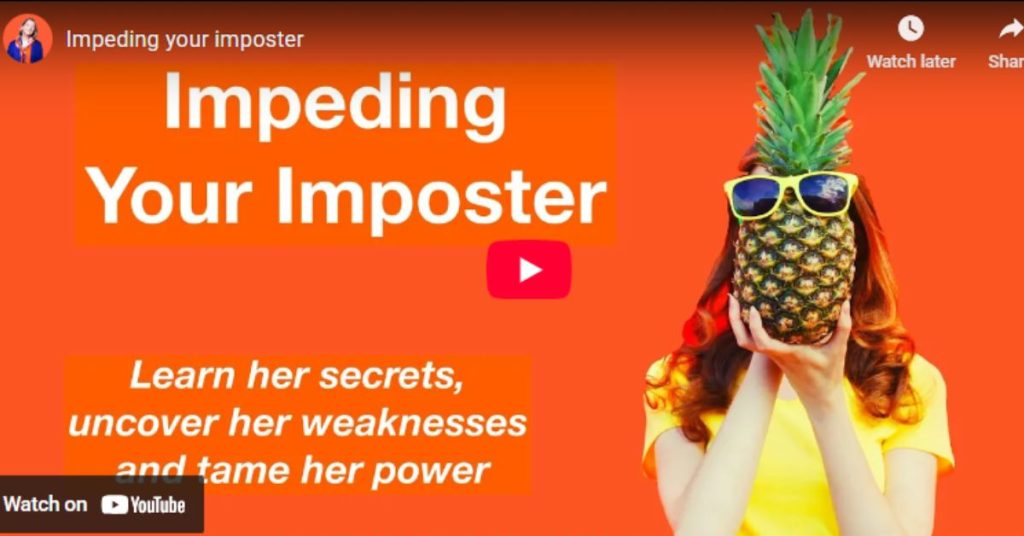
Impeding your Imposter
Imposter Syndrome: A Clear Definition and What To Do Next Many high-achieving women know the feeling well. You are capable, the evidence is there, yet a small voice insists you are about to be found out. Understanding a precise imposter syndrome definition is the first step to taming it. In this video, Karen Brinkley from…

How is your imposter showing up?
Hands up if you’ve ever allowed self-doubt — that sneaky, debilitating voice in your head that asks “Who are you to think you can do that?” — get in the way of your goals and ambitions. Imposter syndrome is a legitimate phenomenon, backed by extensive research and demonstrated to affect professional women much more frequently and more powerfully than…

Are you too…?
Which “too” are you? Too old? Too young?Too bossy? Too backward-in-coming-forward?Too qualified? Too inexperienced?Too nurturing? Too aggressive?Too rigid? Too flexible?Too available? Too unavailable?Too loud? Too invisible?Too grim? Too friendly?Too busy for coffee meetings? Too lacking in networks? New research from Amy Diehl, PhD, Leanne M. Dzubinski, PhD, and Amber L. Stephenson PhD reveals that practically ANY characteristic…
DISCOVER MORE ABOUT:
Coaching and Workshops to Tame Your Imposter
Taming your executive imposter syndrome requires more than awareness: it needs personalised strategies and sustained practice.
Our coaching programs are specifically designed to help women leaders transform their relationship with self-doubt and build authentic, lasting confidence.
What Women Leaders Say about our Imposter Syndrome Strategies
"I used to spend hours over-preparing for every meeting, terrified someone would ask a question I couldn't answer perfectly. The coaching helped me understand my 'Expert' imposter and gave me practical ways to show up confidently without needing to know everything first."
"I was classic Superwoman, trying to excel at everything simultaneously and feeling like a failure when I couldn't juggle it all perfectly. Karyn helped me set realistic expectations and focus on what actually matters for my role."
"The Tame Your Imposter workshop was a revelation. I finally understand why I felt like a fraud despite my track record. Now I catch those thoughts early and respond differently."
"The most powerful shift was learning to rewrite my competence rules. It’s bizarre how we create problems for ourselves and how easily we can fix them with the right tools!”
A Few Questions You Might Be Asking
Is imposter syndrome even a real thing?
Yes — and no.
It isn’t a clinical diagnosis. You won’t find it listed as a mental disorder.
But it is a well-documented psychological pattern, first identified in the 1970s, describing high-achieving people, frequently women, who struggle to internalise their success.
In simple terms: the evidence says you’re capable. Your inner narrative says you’re not.
What makes it powerful isn’t the label, it’s the impact. Chronic self-doubt changes how you speak, how you decide, how you show up, and how much energy you expend proving yourself.
So whether we call it “imposter syndrome” or simply a persistent pattern of self-distrust, it’s real enough to warrant attention.
And the good news? Patterns can be changed.